Archive | Breakfast RSS feed for this section

Cinnamon Raisin Swirl Bread

19 Apr

One of the greatest sandwiches I’ve ever eaten came from a small café and bakery in Cannon Beach, Oregon.  It was a turkey sandwich, replete with fresh vegetables and fortified with huge slices of avocado.  I loved the texture, I loved the flavor, but most of all, I loved the bread.  The bread that enveloped this sandwich was a soft, thick cut white bread with a large swirl of cinnamon spiraling through it.  When I initially saw the description of the sandwich and its bread I was dubious (cinnamon bread with a turkey and avocado sandwich?), but as soon as I took my first bite of the sandwich, all my suspicions went out the window.  The bread was sturdy enough to hold together a generous pile of fillings, but soft enough to make each and every bite of that sandwich an absolute treasure.  The cinnamon flavor in the bread was very subtle, and the swirl in which the cinnamon was contained had the same texture as the rest of the bread. The bread had a pillowy crust, a delicate chew, and it was the perfect savory pairing for a sandwich.

This is not that bread.

Whereas the bread from that bakery was gentle in texture and flavor, this bread is loud and commands your attention from the get go.  The first thing you notice about this bread is the shatteringly crisp cinnamon sugar crust that crackles loudly as you slice into it.  The second thing to catch your eye is the gooey cinnamon swirl that puddles into thick caramelized drops as it slowly creeps out of each slice.

The next aspect is the toothsome chew of the bread, not bubbly and chewy like a crisp ciabatta, but certainly not yielding and soft.  Biting into this bread is like biting into something a bit less sandwich-y, a bit more dessert-ish.  It’s not entirely in the realm of a dessert, but it is certainly the sort of thing that, sliced, toasted, and spread with cream cheese or (why not?) Nutella, would easily satisfy anyone’s craving for a sweet roll or sticky bun.
This is, come to think of it, yet another defining characteristic of this bread.  It’s a perfectly sweet baked good that can be enjoyed as a snack, as an accompaniment at breakfast, or as a companion to a cup of tea, but the whole time you are enjoying it, you are overcome with the mild notion that you might just be getting away with something slightly mischievous.  It’s not a dessert!  It’s a snack!  It’s not a cinnamon roll!  It’s cinnamon bread.  And now that I’ve given you every excuse to eat this bread, I think that pretty much means you no longer have any excuse not to get up and make it right now.

Cinnamon Raisin Swirl Bread

Barely adapted from The America’s Test Kitchen Family Baking Book

I am of the opinion that if you are going to make bread with raisins in it, make bread with raisins in it. I found the original recipe’s raisin requirement to be far too scant, so I’ve taken the liberty of doubling the amount in the version below.  Conversely, if you don’t care for raisins, they can be left out to no ill effect.

1/2 cup granulated sugar

1/4 cup packed dark brown sugar

4 teaspoons ground cinnamon

1 1/4 cups warm milk (not skim, but 1% to whole is fine), heated to around 110 degrees

3 tablespoons unsalted butter, melted and cooled, plus extra for brushing

2 large egg yolks

3 1/2 to 4 cups all-purpose flour

1 envelope (2 1/4 teaspoons) instant or rapid-rise yeast

1 1/2 teaspoons salt

1 cup raisins

Mix the sugars and cinnamon together in a small bowl.  Measure out 2 tablespoons and reserve for the topping.  Whisk the milk, melted butter, and yolks together in a large liquid measuring cup or medium bowl.

Combine 3 1/2 cups of the flour, yeast, salt, and 1/4 cup of the cinnamon sugar in a standing mixer fitted with the dough hook, or in a large bowl.  With the mixture on low speed, or if not using a standing mixer, with a rubber spatula, add the milk mixture and mix until the dough comes together, about 2 minutes.

Increase the mixer speed to medium-low and knead until the dough is smooth and elastic, about 8 minutes.  If after 4 minutes more flour is needed, add the remaining 1/2 flour, 2 tablespoons at a time, until the dough clears the sides of the bowl but sticks to the bottom.  If kneading by hand, turn the dough out onto a clean, lightly floured counter and knead by hand for 12-18 minutes, adding the remaining 1/2 cup flour as needed to prevent the dough from sticking to the counter.

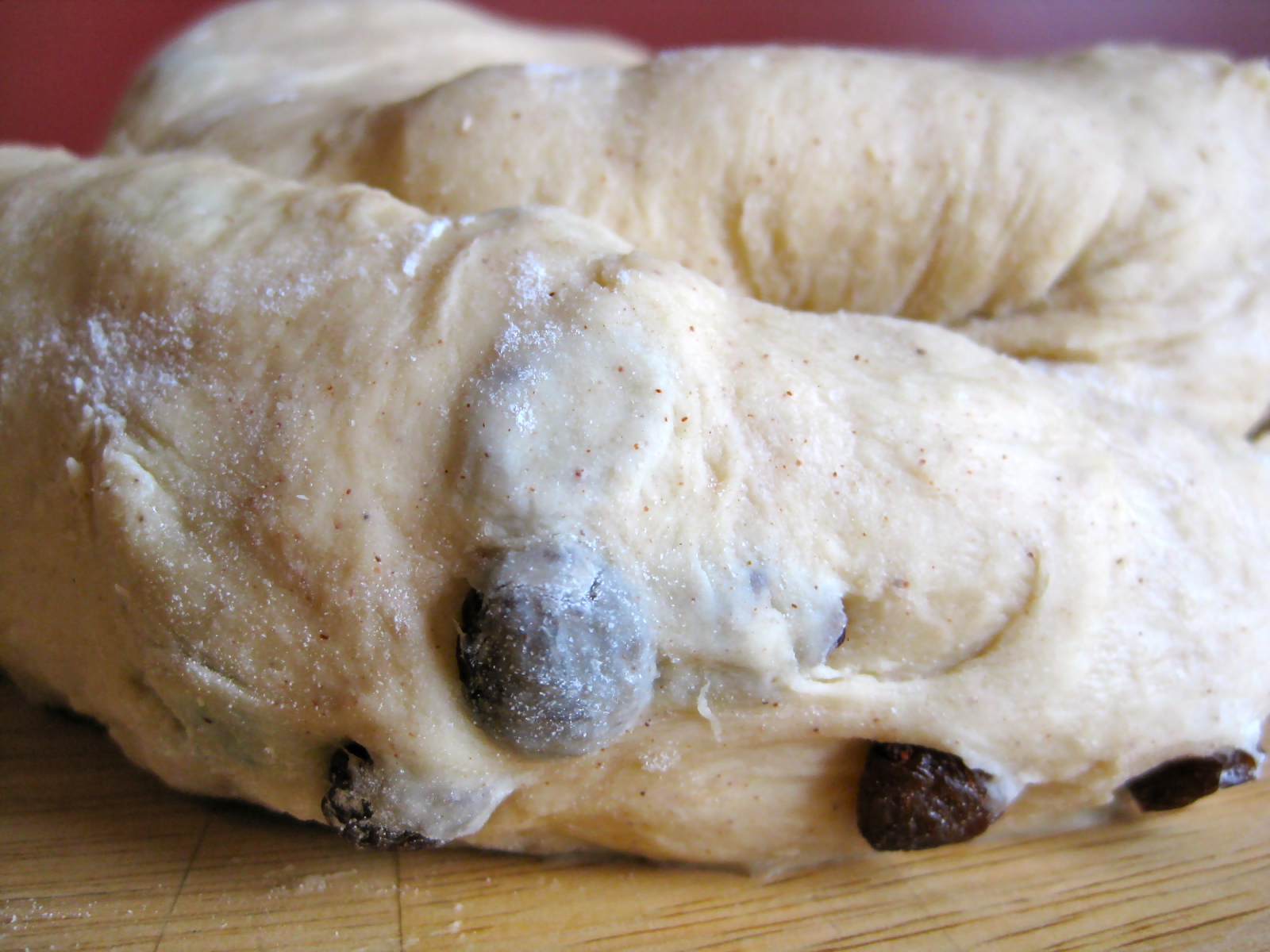
Turn the dough out onto a lightly floured counter and knead in raisins by hand until evenly distributed. Continue to knead the dough, forming it into a smooth, round ball.  Place the dough in a large, lightly oiled bowl and cover with greased plastic wrap.  Let rise in a warm place until doubled in size, 1 to 1 1/2 hours.

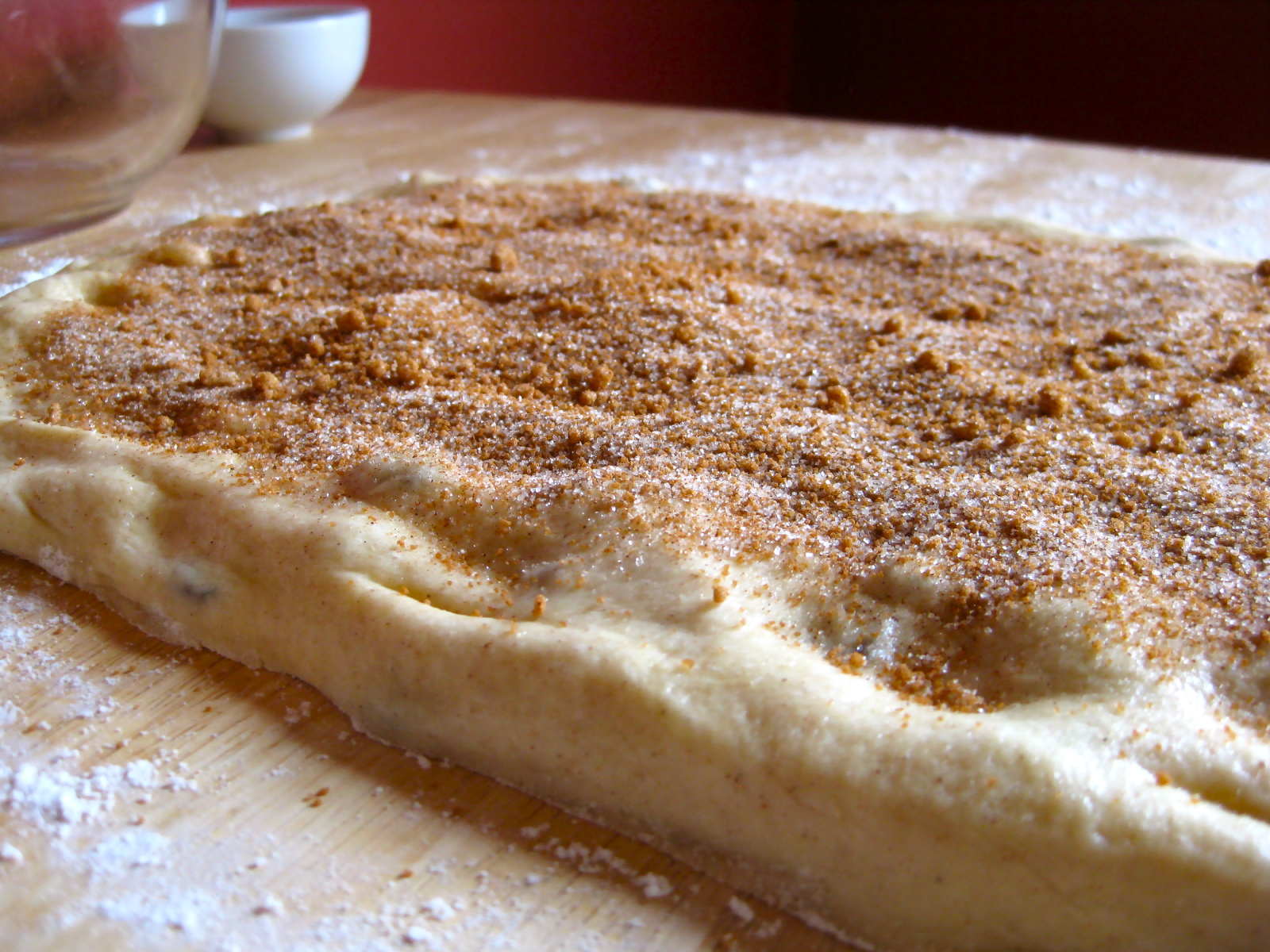
Grease a 9 x 5 inch loaf pan.  Turn the dough out onto a lightly floured counter and press into a 20 x 8 inch rectangle with the short side facing you.  Spray the dough lightly with water, then sprinkle evenly with the remaining cinnamon sugar, leaving a 1/2 inch border at the far edge.  Lightly spray the cinnamon sugar with water until it is damp but not wet.

Loosen the dough from the counter with a bench scraper or metal spatula, then roll the dough into a tight cylinder and pinch the seam closed.  Place the loaf seam side down in the prepared pan.  Mist the loaf with vegetable oil spray, cover loosely with plastic wrap, and let rise in a warm place until nearly doubled in size and the dough barely springs back when poked with a knuckle, 45 to 75 minutes.

Adjust an oven rack to the lower-middle position and heat the oven to 350 degrees.  Brush the loaf lightly with melted butter, sprinkle with the reserved  2 tablespoons cinnamon sugar, then spray lightly with water. Bake until golden, 40 to 60 minutes, rotating the loaf halfway through baking.  Cool the loaf in the pan for 15 minutes, then flip out onto a wire rack and let cool to room temperature, about 2 hours, before serving.

Roasted Poblano Johnnycakes

5 Apr

I grew up reading the Little House books, Laura Ingalls Wilder’s original nine volume set of semi-autobiographical books about pioneer life.  As a harbinger of interests to come, one of the things I remember most enjoying about the books was Laura’s descriptions of the foods she and her family ate.  When times were good and they had a home with four walls, a well-tended garden, and tidy fields of wheat and corn crops, her family ate fresh garden vegetables and fresh homemade cottage cheese.  When times were rough and months were spent living in a covered wagon or outliving seven straight months of blizzards, they ate bread, potatoes, and, if they were lucky, whatever wild game they could shoot.  Every single thing they ate was cooked in cast iron or baked within an open fire.

Recently my husband and I started reading the Little House books to our preschool-aged son.  In addition to the occasional on-the-fly edit in order to omit the rather blunt and one-sided talk about the local Native American tribes (the original inhabitants of the land on which Laura’s family was settling), we have spent a great deal of time discussing the different types of food that Laura and her family ate.  (We also spent a great deal of time talking about food when we read Farmer Boy, since a substantial portion of that book is spent discussing the mountains of food that Laura’s husband Almanzo ate when he was a boy—every meal seemed to be presented as an exercise in competitive calorie intake, no doubt as a result of their twelve hours a day of hard manual labor on a farm.)  Much of the food of the era, as well as the manner in which people got that food, is not only unfamiliar to a city-dwelling boy of 4.5 years of age, it’s also nearly unimaginable.  What’s a prairie hen?  What is salt pork?  And did you really just say that Pa shot a bunny rabbit so the family could roast it for Christmas dinner?

Perhaps in an effort to distract our son from the fact that Laura’s Pa could frequently be found shooting and skinning what is regarded, to some people in this house, as being the world’s greatest animal, I decided that we should focus our attention on a pioneer-era food that was less fraught with peril and woe.  That is, in essence, the long story of how I came to make johnnycakes.

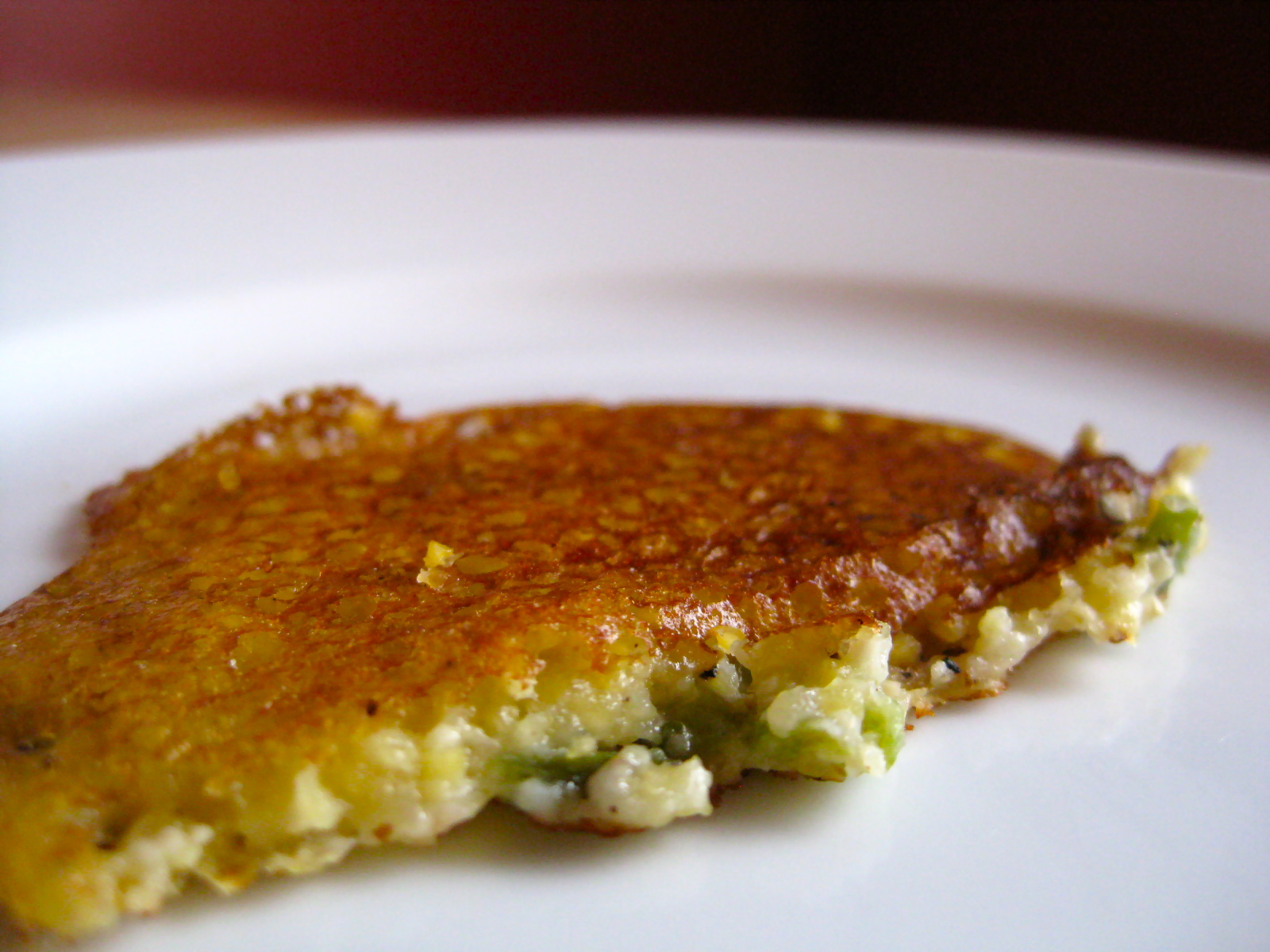
As luck would have it, one of my favorite breakfast food bibles, James McNair’s Breakfast, happened to have, smack dab in the center of the book, a simple recipe for Johnnycakes.  A quick perusal of the ingredients led me to some automatic adjustments, namely the immediate realization that these crispy corn cakes were just begging to be paired up with something mildly spicy and smooth to counter the sweetness and crunchiness.  One roasted poblano pepper later, I had exactly what I had imagined.

When paired with a soft fried egg and an additional sprinkle of chopped roasted poblanos, you’ve got yourself one special meal, suitable for breakfast, lunch, or dinner.  Though not entirely traditional in the pioneer sense, I’d like to think that, were the times good and the livestock thriving, it might even possibly be considered Laura-approved.

Roasted Poblano Johnnycakes

Partially adapted from James McNair’s Breakfast

1 medium-sized poblano pepper

1 cup white flint or other stone-ground cornmeal

1/2 teaspoon salt

3/4 cup boiling water

2 tablespoons unsalted butter, melted

1 teaspoon sugar

1/4 cup milk

Set your oven’s broiler to high heat and place an oven rack on the highest shelf, nearest the heat of the broiler.  Set the poblano pepper on a heavy baking sheet, then place directly under the broiler.  Let the skin of the pepper blister, darken, and flake.  Turn pepper several times, allowing its skin to blister and flake on all sides.  When pepper’s skin has been uniformly darkened, remove pepper from oven and set on a plate, cover with aluminum foil, and allow pepper to cool to the touch and the skin to become loose.  When pepper has cooled slightly, remove the skin.  Remove and discard stem and seeds.  Roughly chop roasted pepper and set aside 1/4 cup to add to the johnny cake batter.

In a bowl, combine the cornmeal and the salt, then gradually add the boiling water, whisking to prevent lumps and integrate cornmeal and water.  Stir in the melted butter, sugar, and milk.  Stir in 1/4 cup chopped roasted poblano pepper.

Meanwhile, heat a griddle or a large, heavy skillet over medium-high heat, then generously brush with melted butter.

Spoon the batter, about a heaping tablespoon for each cake, onto the cooking surface.  Cook turning once, until crisp and golden on both sides.  Serve hot.  If desired, top with a soft fried egg and an additional sprinkling of chopped roasted poblano pepper.

Honey Nut Granola

18 Feb

It’s easy be a fan of granola, what with its crunchy bite and hearty toasted flavor.  The bad thing is, along with that pleasing mixture of satisfaction and fullness that granola provides, what you are also getting when you tuck into a big bowl of granola is sugar.  Lots and lots of sugar.  Now, clearly I am no opponent of sugar (see here), but if I am going to eat a sweet breakfast, I am not going to attempt to conceal that fact under an attempted guise of healthfulness.  A cinnamon roll is a cinnamon roll, and granola should just be granola.  You’ve got to know what you’re getting into.

Sacrificing sugar and oil (another common granola ingredient found in unexpectedly large quantities) in a batch of homemade granola does not mean you will be left wanting for taste.  As with most things in the kitchen, when you remove something you must then add something, and in the case of this granola, you’ll actually be adding two somethings: apple cider and honey.

Combined with a generous helping of nuts and what seems like an unrealistic amount of cinnamon, this granola exits the oven smelling like tray of freshly baked of cookies, but in reality it boasts the sort of healthfulness that is ordinarily associated only with the likes of, well, granola.

I imagine that most people will get to the final portion of this recipe and immediately walk away, eyes rolling.  Two hours in the oven?  And you have to stir the stuff every 15 minutes?  It’s true that this granola needs to be moderately babysat while toasting in the oven, but if you break down those 15 minute intervals, you realize that many activities already cater to a repeated 15 (or 20, if you want to stretch it, which, honestly, does no harm) minute break.  How much television do you watch in one evening?  Does a commercial come on just about every 15 minutes?  Yes, it does.  Are you spending a leisurely Saturday afternoon at home with some reading?  Wouldn’t you enjoy getting up every 15 minutes to stretch your legs?  Oftentimes I start assembling this granola (which takes all of 5 minutes) while I am beginning dinner preparations.  By the time we have eaten dinner, cleaned up, and bathed the kid, the granola comes out of the oven just before we get settled in to read bedtime stories.  Setting aside a few seconds every 15 minutes to stir the granola isn’t even noticeable, and when we go to bed we know that we’ll be waking up in the morning to the lingering scent of apples, cinnamon, and nutty toasted oats.  If that’s my reward for stirring something a mere 8 times, I’ll gladly take it.


Honey Nut Granola

6 cups rolled oats

1/3 cup sliced or slivered almonds

1/3 cup roughly chopped walnuts

1/3 cup roughly chopped pecans

1/4 cup wheat germ (optional)

3 tablespoons cinnamon

1/2 cup fresh pressed or unfiltered apple cider

1/3 -1/2 cup honey, depending on how sweet you like your granola (I find that 1/3 cup is perfectly, not overly, sweet)

1 tablespoon vanilla extract

1/2 – 3/4 cup raisins

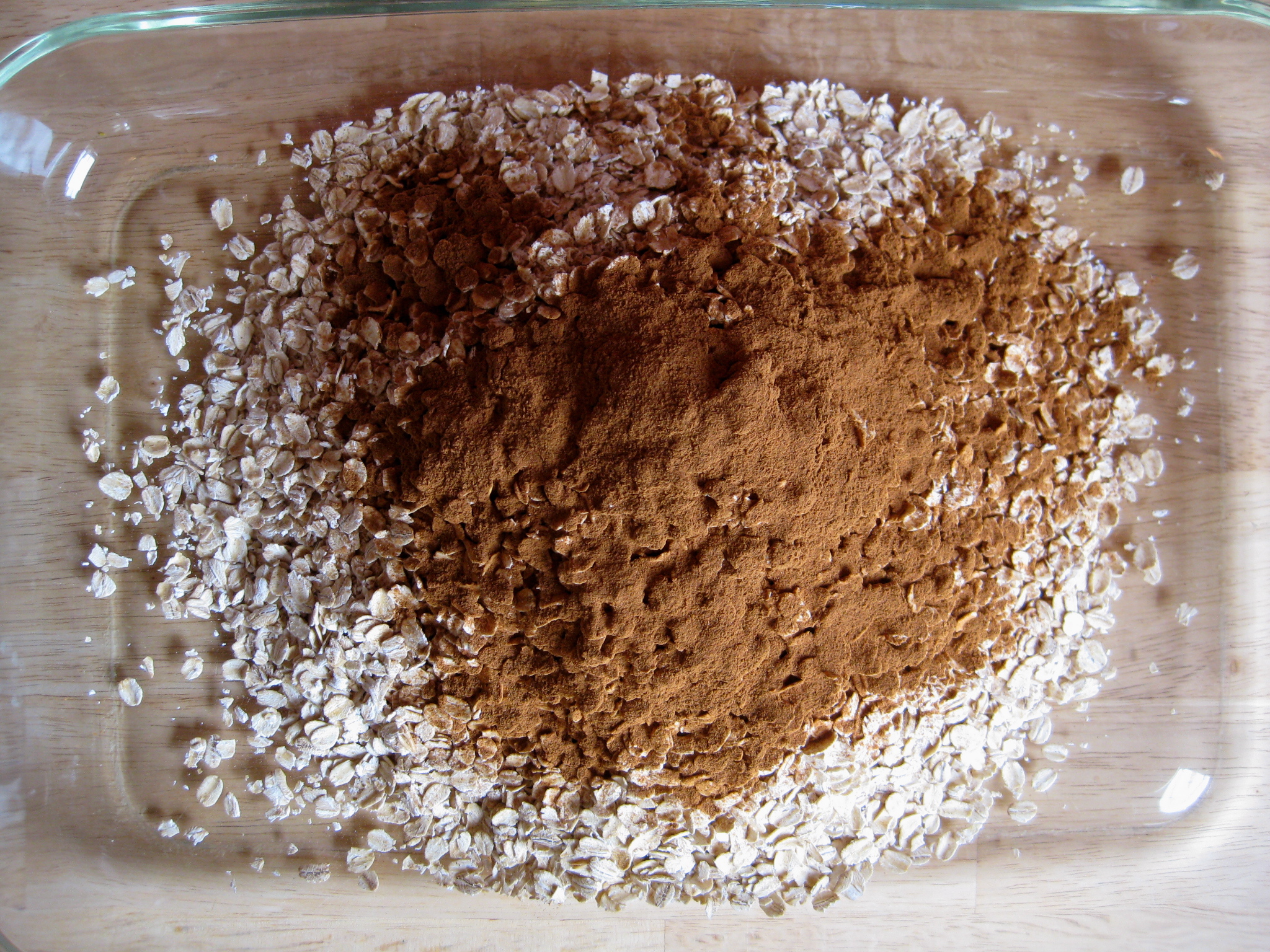
Preheat oven to 250 degrees.  In a large rectangular baking dish, toss together the oats, nuts, wheat germ (if using), and cinnamon.  In a separate bowl, thoroughly whisk together the apple cider, vanilla extract, and honey.  Pour the apple cider mixture over the oat mixture and toss to coat evenly.  When done tossing, make sure to spread the oats out evenly.

Bake uncovered for about 2 hours, stirring every 15 minutes, until the mixture is dry.  Remove from oven and stir in the raisins while the granola is still hot.  Cool granola to room temperature before storing in a tightly covered container at room temperature.