Archive | Citrus RSS feed for this section

Ponzu-Marinated Flank Steak

23 Jan

There is a restaurant down the street from me that just might end up unseating the other restaurant down the street from me as the World’s Most Dangerous Restaurant to Have Down the Street from You (which is not to be confused with our other nemesis, The World’s Most Dangerous Food Cart to Have Down the Street from You).  My will power, it is weak.  When faced with the sweet memory of duck breast and lemongrass salad, I grow loose in the knees and wallet, and all I want to do is run down the street and place my order immediately.  I hear the name of a certain restaurant, and I am like a seal that has been trained to bark on command.  Spicy!  Thai!  Street!  Food!  Now!  Completely puzzling, however, is the added desire to eat a particular meat dish from the other, newer dangerous place, a meat dish that, in any other place, I am sure I would loathe.

Picture this: super thin slices of steak (I know!  I am talking about steak! Who am I?) are marinated in a savory, bright, citrusy mix of kelp and lime juice.  Then the meat gets skewered and stuck directly into a roaring fire, searing in every possible place and becoming incredibly, impossibly juicy.  The skewer, still sizzling, is brought directly to your table, where you try with all your might to maintain a sense of dignity and manners while you ravenously devour the meltingly delicious meat.  No one is more surprised than me that I enjoyed this dish as much as I did.  For a split second, I was transformed into a dedicated carnivore, a person who actually devoured meat.  It was utterly bizarre.

A few weeks ago, the holidays in full swing, I was overcome with the idea I had to try and recreate the dish at home, a task made difficult by the fact that a) I didn’t really know what exactly made up the marinade enveloping the meat in question, and b) it is winter, and therefore my access to an open fire over which to cook things is fairly well nonexistent.  The first problem was easily remedied, as a small amount of hunting around led me almost immediately to an old specials menu from the Dangerous Restaurant, and a bit more poking around led me to this great New York Times recipe for ponzu marinade, which happened to be the mystery flavor.  Ponzu, as it turns out, is sort of like a Japanese vinaigrette, and can be used in everything from salads to marinades.  One of the main flavor profiles in ponzu is kombu (dried kelp), which provides a hefty dose of natural glutamates to give the ponzu a fat (but not fatty), umami taste that rounds out your taste buds.  It also helps break down the fibers in meat, tenderizing as it simultaneously flavors.
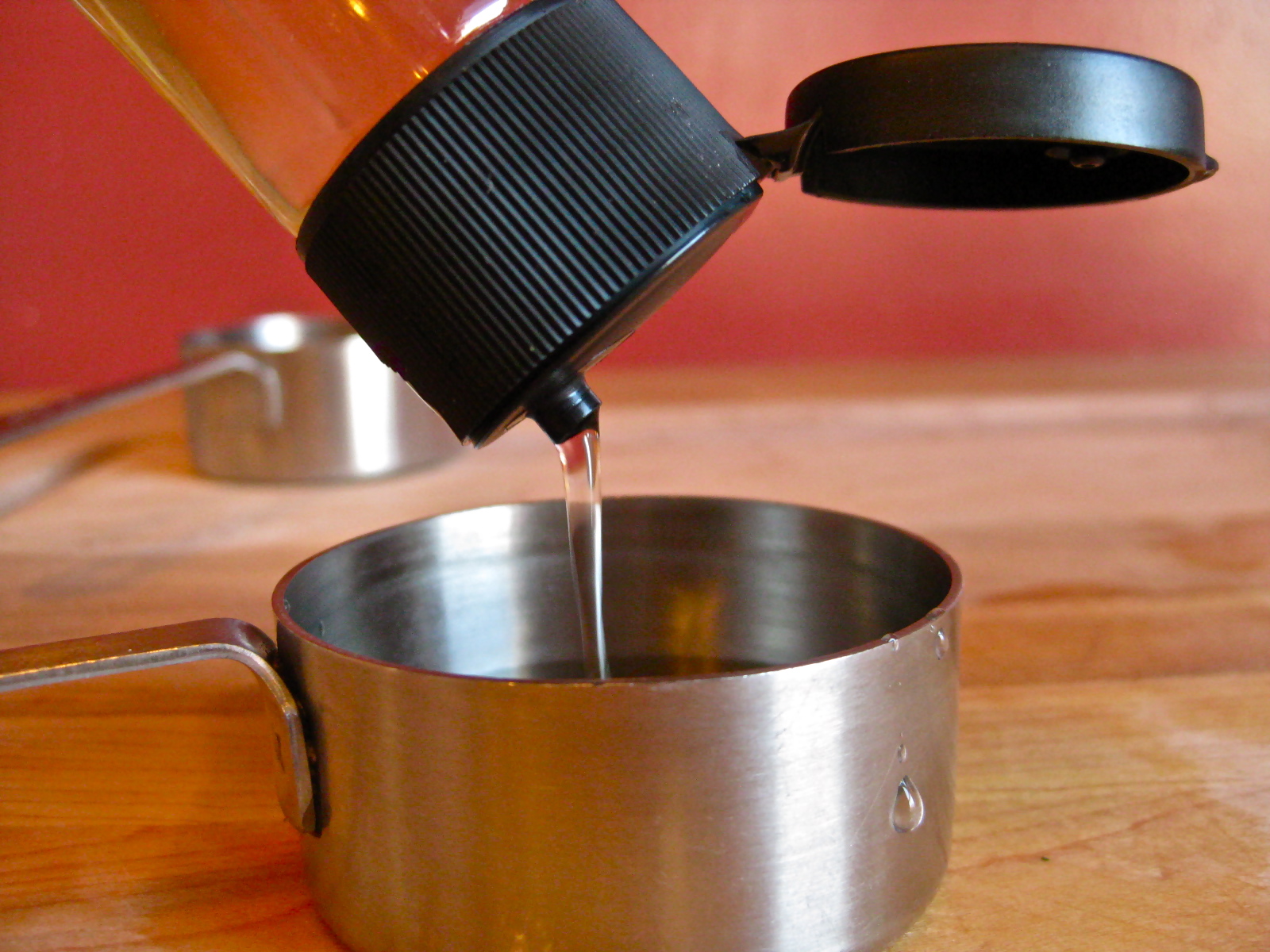
The other problem, I am afraid, could not really be solved, as winter in the PNW means cold and wet, and cold and wet are no friends of the grill.  In a pinch, I fired up our stovetop grill pan as hot as it could possibly get, and hoped that it would do the trick.
To be quite honest, it was pretty close.  The only thing missing was the melting, seared texture that can only be achieved by sticking a piece of meat into a wall of fire, but the flavor was dead on.  Bright, but also slightly mysterious, there is a lot going on in each bite.  I am waiting for summer to arrive so I can cook this dish again as I really want to (massive pile of fire, I await you), but, in the meantime, this version is certainly no slouch.

Ponzu Marinated Flank Steak

Sauce from Mark Bittman in The New York Times

2/3 cup fresh lemon juice, more to taste

1/3 cup fresh lime juice, more to taste

1/4 cup rice vinegar

1 cup good-quality soy sauce

1/4 cup mirin

1 3-inch piece kombu (dried kelp)

1/2 cup (about 1/4 ounce) dried bonito flakes (or, in a pinch, 1 tablespoon Vietnamese fish sauce)

Pinch cayenne

1 pound flank steak

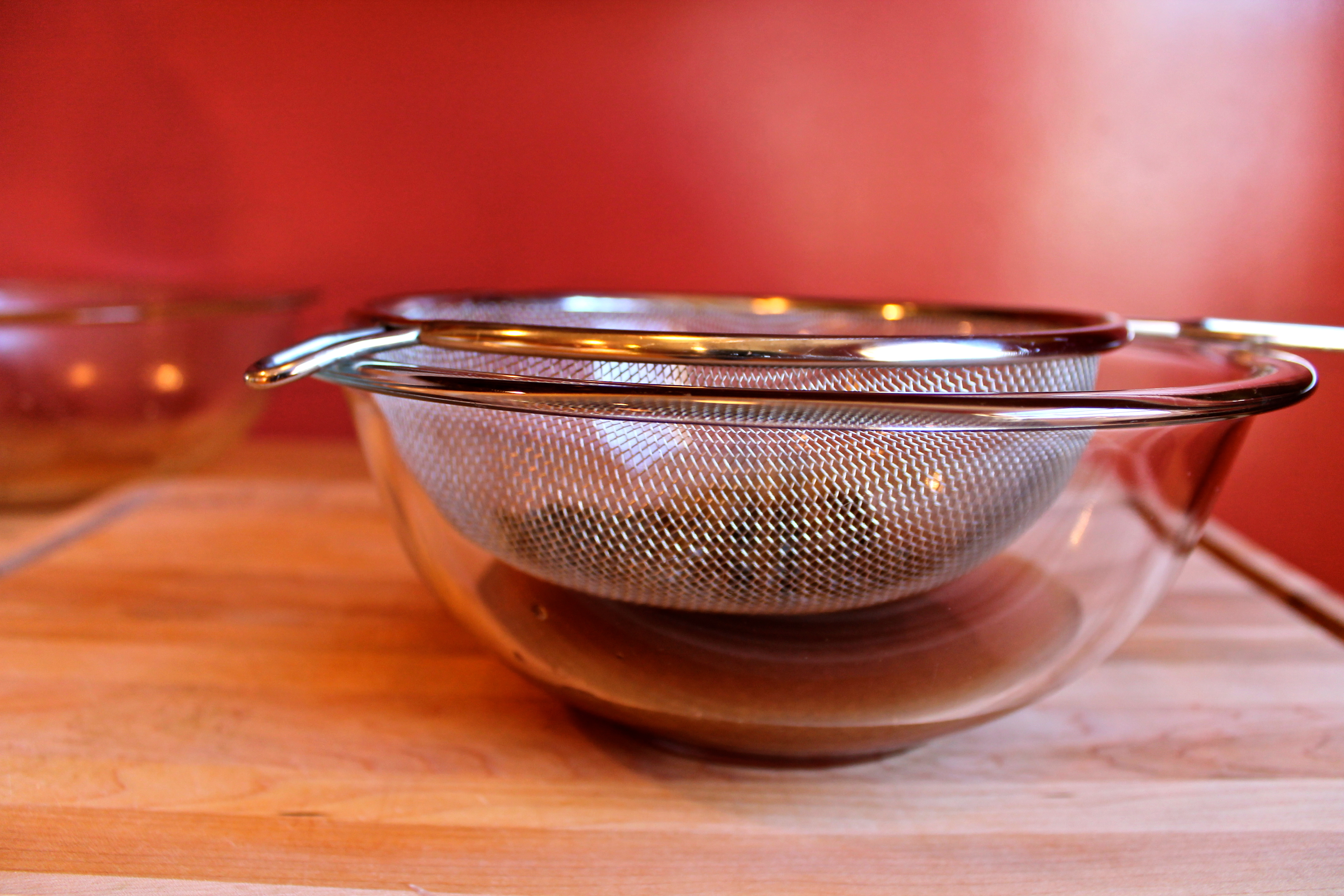
In a bowl, combine all ingredients except flank steak. Let sit for at least 2 hours or overnight. Strain.

Slice the flank steak against the grain into thin strips.  Add the strips of steak to the bowl of ponzu, and marinate in the refrigerator, covered, for at least 1 hour.  When ready to cook, drain the meat and set aside.

Heat an outdoor grill as high as it will go, or heat a stovetop grill pan on high.  When the grill is incredibly hot, add the strips of steak, cooking as many as you can without crowding the meat.  The meat will cook very fast, only needing a minute or so on each side.  If your grill is not as hot as can possibly be, it might take two minutes per side.  What you are looking for are crisp edges and a remaining quality of juiciness.  It might take a bit of trial and error (depending on how thick your slices are and how hot your grill is), so start by cooking two or three pieces at a time and seeing how long they take.  The meat is thin, so the cooking time should not be more than a couple of minutes per side.

Hazelnut Orange Pesto

5 Jan

For fifteen years now, I have been subscribing to the New Yorker.  During that span of time, there have been maybe three instances—four, tops—in which I have not greeted the arrival of yet another issue of the magazine by plopping the new week’s issue upon a vast pile of previous weeks’ issues.  A very good friend of mine, who, at the time, was also a longtime subscriber to the New Yorker, and also, incidentally, unable to keep up with the barrage of unstoppable arrivals flooding his mailbox, once began to refer to every new issue of the New Yorker as “the dead rat,” due to its unassailable, somewhat onerous presence in his mailbox.  Plang!  The flap of the mailbox just slammed shut.  What’s new?  Oh, yes.  The dead rat has arrived.  Add it to the pile.

Other people I know who subscribe to the New Yorker are perfectly fine with the sight of piles of unread magazines littered about their home.  Perhaps it speaks of a more developed sense of ease on their part when it comes to matters of reading materials that those people can accumulate back issues of the New Yorker and never blink an eye.  I get more than three weeks behind and I start to develop cold sweats.  Maybe because of that fellow I read about who was something like a year and a half behind on the New York Times, a newspaper he read every single day, though not in its entirety every single day, which meant that when it took him a couple of days to make his way through a copy of the Times, he’d be a couple of days behind, well, the Times, when he finished.  Take too long to read the paper over a long enough period of time and, look, there you are, reading an issue of the New York Times from 2007 as you ride the subway to work in 2009.  Sometimes it feels like a slippery slope between getting a couple of weeks behind on the New Yorker and becoming that man and his archive of New York Times reading matter, perpetually living in the past just so he can leisurely work his way towards the future.  (Also, it bears mentioning that the story about the man and the New York Times?  Yeah, I read about it in the New Yorker.)

The main culprit in my chronic struggle to maintain a current reading schedule with the New Yorker is the fact that I insist on reading every single thing in the magazine, cover to cover.  I read the listings for what bands are playing at what clubs, what new building by what new architect is currently being built to house what new condo complex, and what new restaurants are opening.  You may think I am insane to take on such a seemingly worthless endeavor, but let me tell you something.  Had I not insisted on reading a review of a new restaurant that opened up in the West Village, I would have never read about that restaurant’s offering of a small, delicious plate of crusty bread topped with hazelnut orange pesto.  Not helping my reading situation at all, as soon as I read about the combination, I put down my magazine to make it.

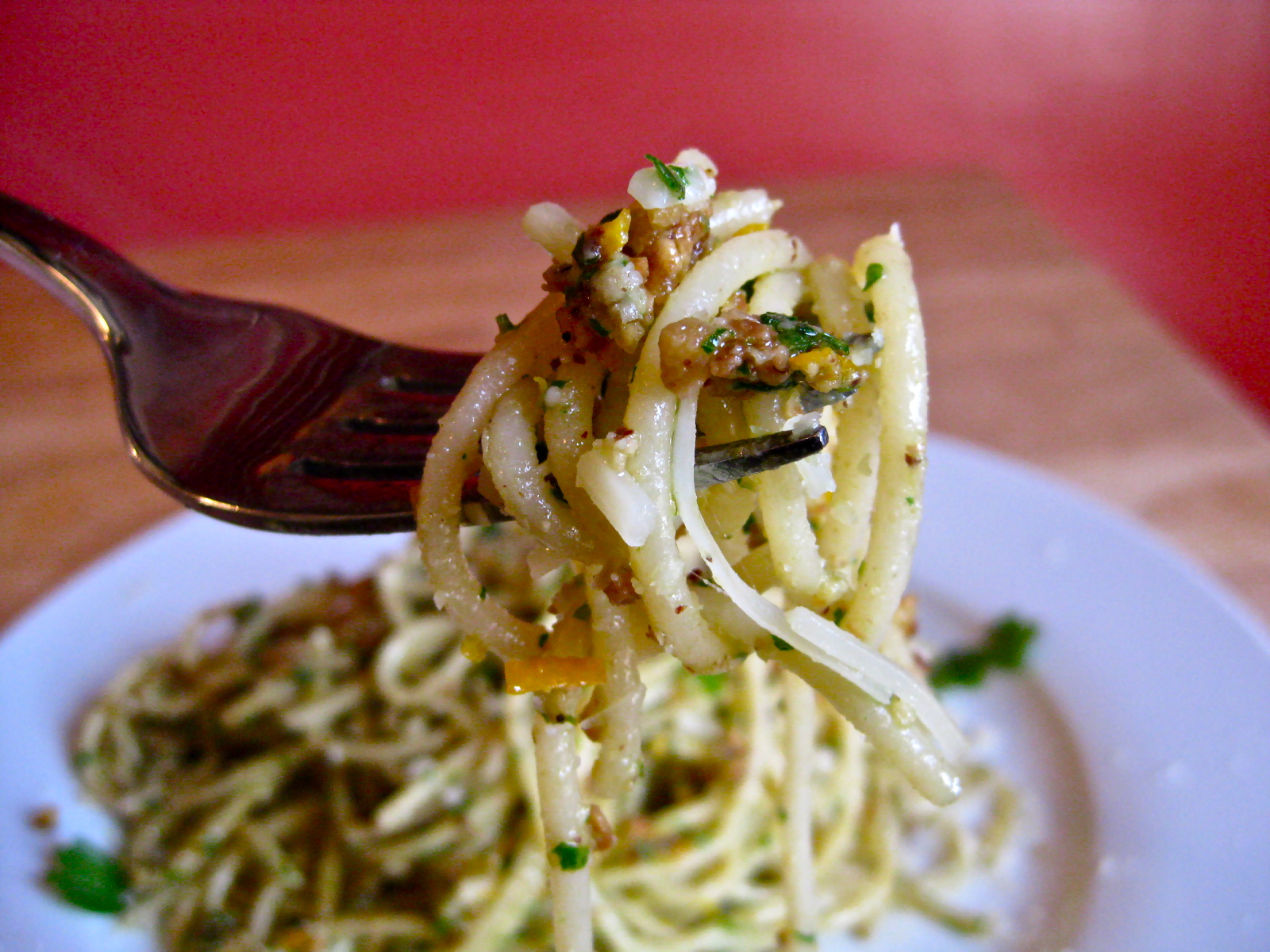
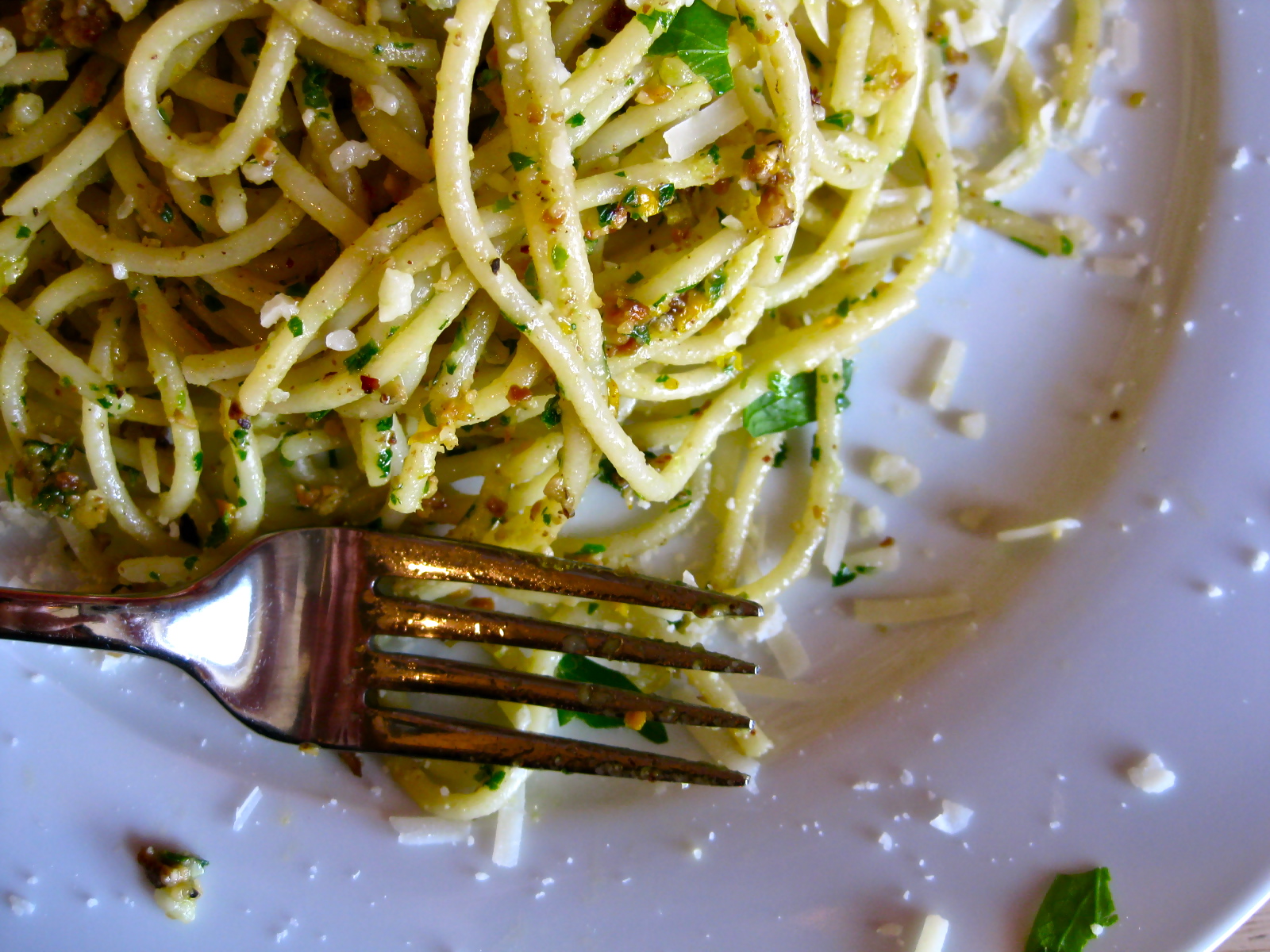
Not surprisingly, the pairing of the two elements is absolutely fantastic.  The robust flavor of the toasted hazelnuts gets a nice brightness from the orange zest, and when whirled together with a generous glug of olive oil and a large handful of Italian parsley, the pesto comes together as a well-rounded, satisfying sauce for pasta, topping for crostini, or even a nice embellishment to a pile of sautéed greens rested upon a bed of thick, belly-warming polenta.  I savored each bite of this warm, filling meal, and I am not the least bit ashamed to admit that while eating it, I cracked open an old back issue of the Atlantic.  From September 2010.  Don’t worry.  I’ve let that subscription lapse.

Hazelnut Orange Pesto

If you are going to make this pesto as a sauce for pasta, reserve about ½ a cup of the pasta’s cooking water to add into the pesto when you toss it with the pasta.  This will help the pesto loosen up a bit and maintain more of a sauce-like consistency.

1 cup hazelnuts

1 cup loosely packed Italian parsley leaves

1 large clove of peeled garlic

2 tablespoons grated orange zest

¼ cup grated Parmesan cheese

¼-1/3 cup olive oil

salt and pepper

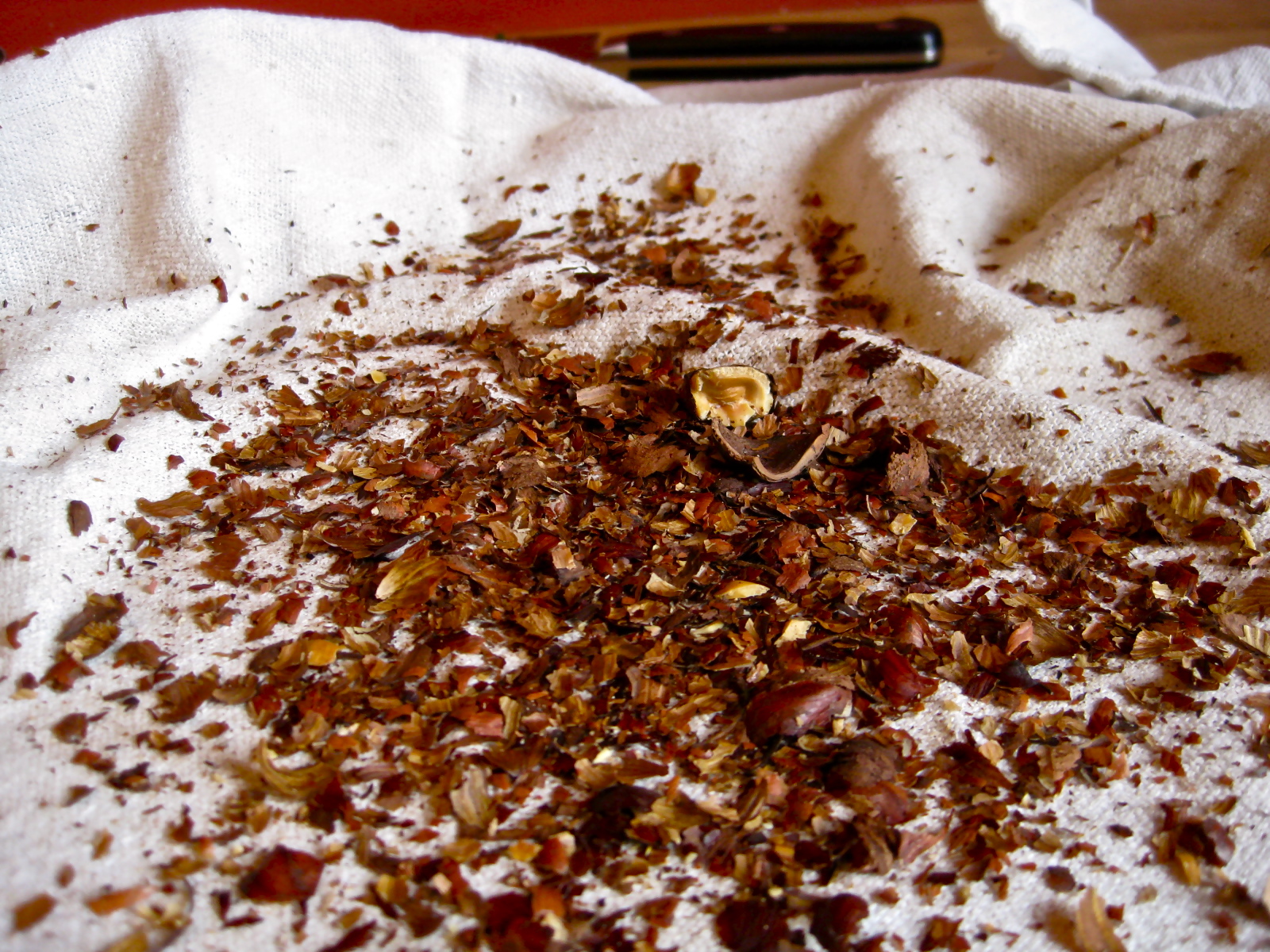
Preheat oven to 350 degrees Fahrenheit.  Place hazelnuts on a baking sheet, and toast for 15 minutes, until the nuts are golden brown and the skins are beginning to peel free.  Remove the toasted nuts to a clean dishtowel.  Fold the dishtowel over the hazelnuts, and vigorously rub the towel around to slough the skins off of the nuts.  If you don’t remove all of the skins, don’t worry.  You just want to remove enough of the skins to ensure that your nuts won’t taste too bitter.

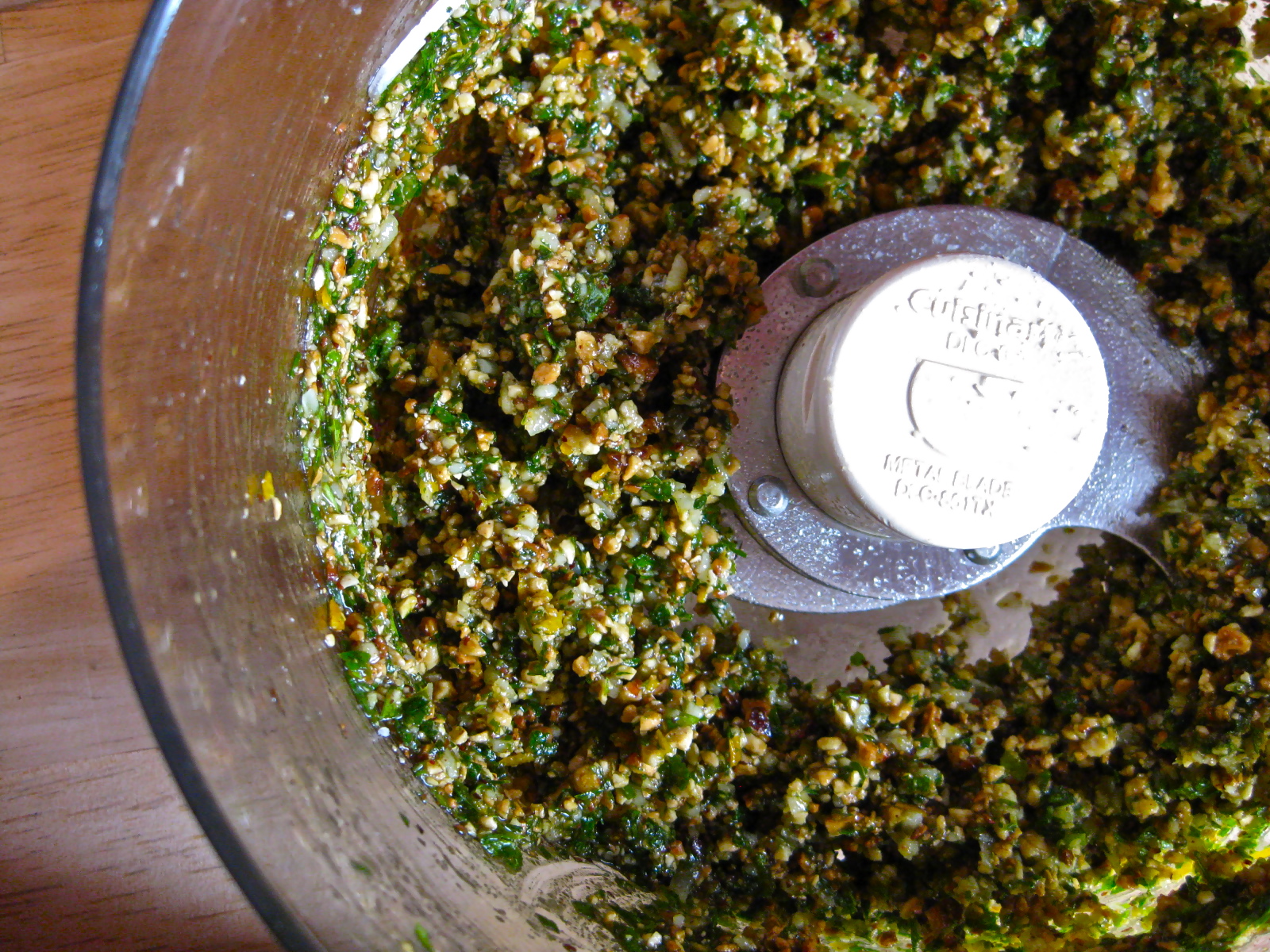
In the bowl of a food processor, combine the nuts, parsley, garlic, orange zest, Parmesan cheese, and ¼ cup of olive oil.  Pulse the mixture for about 20 seconds, until the ingredients are chopped and the nuts still have a good amount of texture (if you process the mixture too long, the hazelnuts run the risk of turning into a paste).  If the mixture looks a bit too sturdy, add in the remaining olive oil, one tablespoon at a time, pulsing briefly after each addition until the pesto reaches your desired consistency.  Add salt and pepper to taste.

Use as a topping for crostini, a sauce for pasta, a dressing for greens, etc.  I’ll bet this would taste great dolloped on top of a nice firm piece of white fish.

Chocolate-Dipped Lime Shortbread

8 Dec

It seems somehow unbelievable, but up until last year, I had never before heard of a holiday cookie exchange.  Then I was invited to one, and it was like someone had thrown open the door to a whole new world of crisp, buttery delights.  If you’ve never heard of a cookie exchange either, the basics are thus:

-You make a bunch of cookies.

-Other people make a bunch of cookies.

-You and those other people gather at a predetermined location to exchange a handful of each cookie in attendance.

-You leave with as many cookies as you came with, only now your cookies are made up of a glorious mix of several different types of cookies.

And I went most of my life without knowing about this magnificent event?  Unfathomable.  Thankfully, this year I was invited to yet another cookie exchange, and it seems as though we somehow lucked into the greatest, most creative group of cookie makers for which anyone could ever hope.  When we left that cookie exchange, we had been blessed with extra-spicy ginger cookies, peanut butter Nutella cookies (how I’ve never been exposed to those little miracles before, I’ll never know), tiny little pecan pies, anise butter cookies, and something called an espresso crunch bar that I eventually had to get rid of after I found myself unable to resist its charms for the tenth time in one evening, leading me to stand in front of it whilst pointing angrily and yelling in a stern voice, “You are not the boss of me!”

A success all around, it seems.

Of course, in order to partake in a cookie exchange, one must bring along a selection of cookies, and I dutifully did my part.  I’ve always been a big fan of shortbreads that have been heightened with a bit of citrus, so my choice of cookie was easily made.  As an added bonus, choosing to shape the dough into logs and cut them later made for a great, simple method of breaking up my cookie preparation into a couple of laid-back evenings.  One night I made the dough and shaped it, the next night I baked the cookies.  The morning of the cookie exchange, I dipped the cookies in just a bit of melted chocolate, giving them a touch of something extra.  It might be debatable if we really need to add extras during the holiday cookie season, but why go down that road?  Make some cookies, then exchange them, gift them, or, if you are brave, leave them in your house to be enjoyed over the remaining weeks.  Okay, days.  Okay, day, singular.  You know what?  Just send the cookies to work with your spouse.  It’s safer that way.

Chocolate-Dipped Lime Shortbread

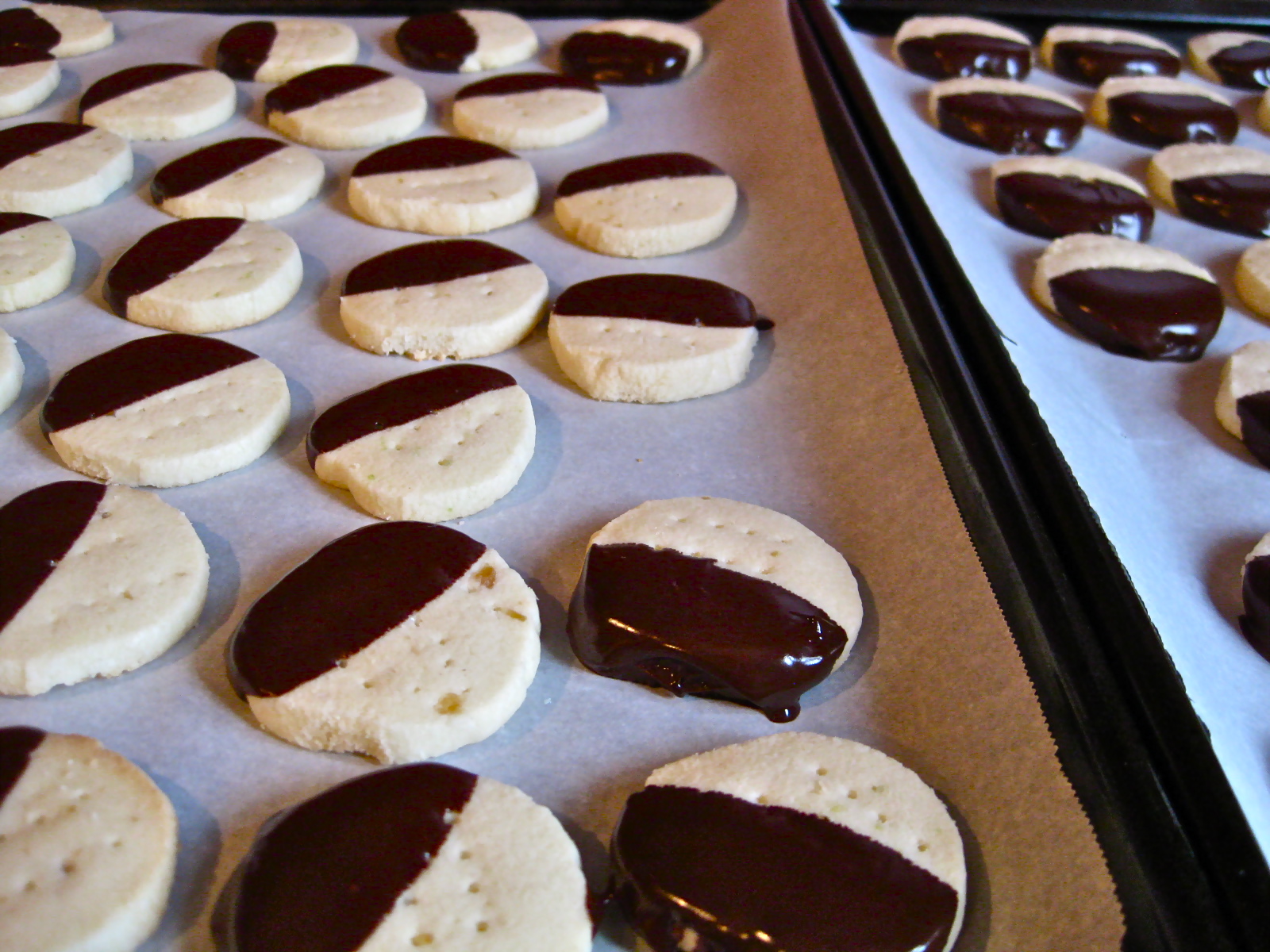
Keen eyes may notice that these pictures show two types of shortbread.  Because the cookie exchange I attended require each person to make 7 dozen cookies, and this recipe makes 4 dozen cookies, I doubled the recipe and made one batch of lime shortbread and one batch of ginger shortbread.  To make ginger shortbread, simply add two tablespoons of finely chopped candied ginger in place of the two tablespoons of lime zest.

1 cup (2 sticks) unsalted butter, at room temperature

1 cup powdered sugar

1 egg yolk

2 cups unbleached, all-purpose flour

½ cup cornstarch

2 tablespoons finely grated lime zest

5 ounces bittersweet chocolate, chopped into smallish chunks

In a large bowl, beat together the butter and powdered sugar until light and fluffy.  Add the egg yolk and blend well.  Add the flour and cornstarch and beat until well mixed.  Add lime zest and mix until combined.

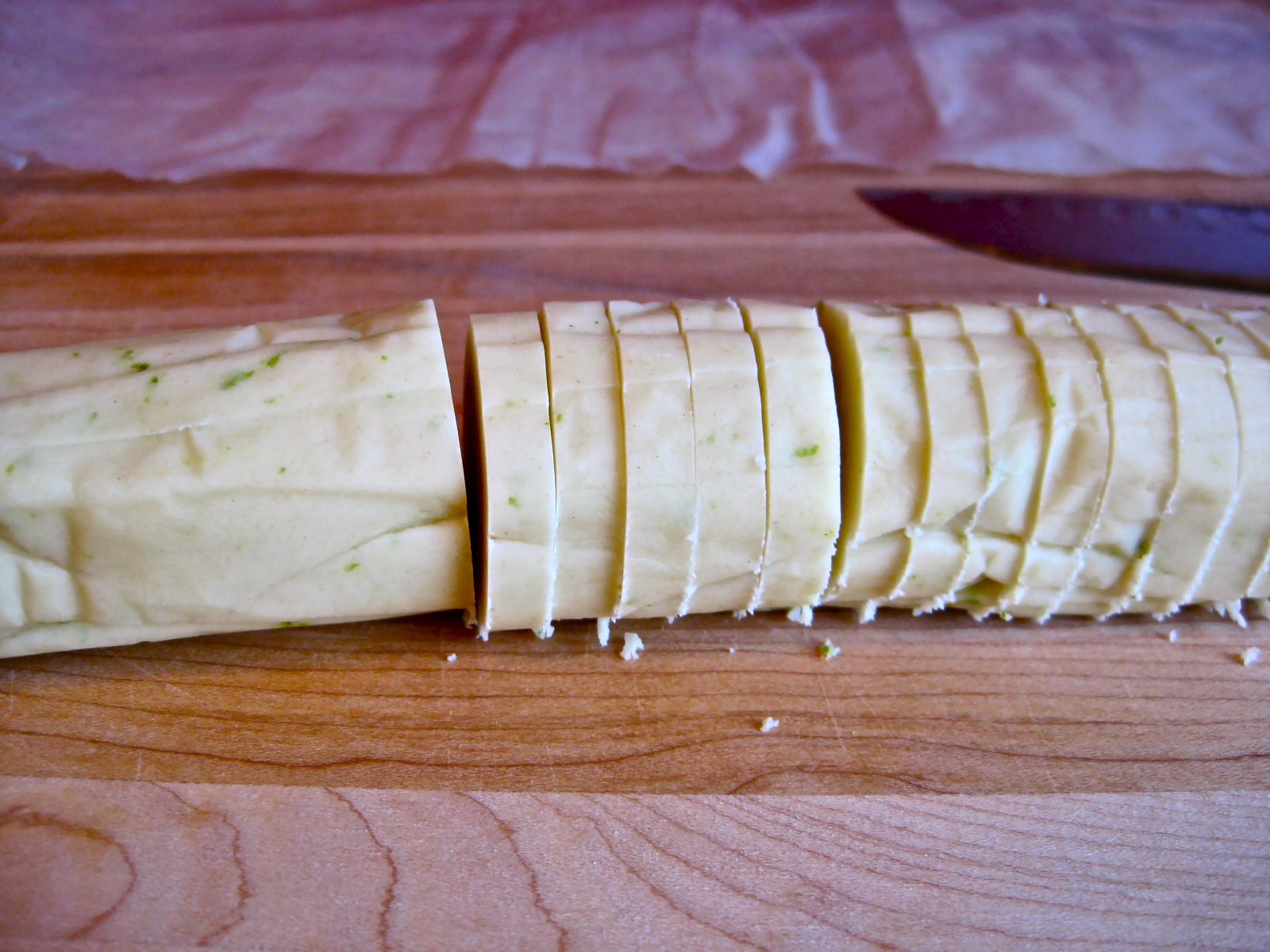
Dive the dough into 2 batches.  Shape each batch into a log roughly 12 inches long.  Wrap each log tightly in plastic wrap, then refrigerate for at least 2 hours, or until firm (tightly wrapped, dough can be left refrigerated for up to a week).

Preheat oven to 350 degrees Fahrenheit.

Cut dough into ¼-inch slices.  Bake the cookies on parchment-lined baking sheets for 10 to 13 minutes, or until the cookies are mostly set in the middle and just starting to turn light golden brown at the edges.  Prick tops of cookies with a fork (to allow steam to escape and ensure a crisp cookie), then remove to a wire rack to cool completely.

When cookies have cooled, heat the chocolate on top of a double boiler until it is smooth and glossy.  Alternately, you can melt the chocolate in the microwave by heating the chocolate in a microwave-safe bowl in 20-second increments, stirring in between each session, until the chocolate is mostly melted.  Let the chocolate sit for a minute or so to melt completely, then stir to make it smooth.

Line several baking sheets with parchment paper and set aside.  Dip each cookie into the melted chocolate, coating it halfway.  I ended up dipping each cookie by tipping the top into the chocolate and leaving the bottom mostly uncovered, because I found this method to be the easiest.  Place each dipped cookie on the parchment paper and allow to the chocolate to harden completely before packing up or transporting.

Makes 4 dozen cookies.