Grilled Peaches and Sausages with Almond Herb Bulgur

21 Jul

There is a fierce debate amongst people concerning whether or not sweet and savory foods belong together.  I imagine this debate is much like the fracas surrounding the polarizing opinions people have about cilantro (It tastes like soap!  No, it’s delightful!), and, to be completely honest, I totally understand why.

Up until a few years ago, I, too, was not a fan of mixing my sweet foods with my savory or salty foods.  Oh, sure, I was amenable to a nibbling of sweet and salty roasted nuts, but, really, who isn’t?  My aversion to sweet foods that mingled with savory foods was more an issue of one component of the meal taking precedent over every other flavor aspect.  Salted caramels were always too salty, and sprinkling brown sugar or maple syrup on winter squash always seemed like a bit much to me.  If you tried to talk to me about pairing fried chicken with waffles and maple syrup, you could be sure that I would shut you down immediately.  No.  Don’t even talk about it
Then, right around the end of 2005, newly pregnant and completely and wholly averse to all foods everywhere, something happened to my taste buds.  At first I was repelled by food, unable to glimpse any food at all without feeling like my stomach was going to violently force itself out of my body.  Then, after 100 solid days of nausea, I emerged from my unintentional fast as a timid and cautious eater.  Cut to around six months in, my taste buds all out of whack and not craving certain foods so much as certain sensations, and suddenly I could be found standing in the middle of the kitchen, spicy grilled chicken breast in once hand, bowl of vanilla yogurt in the other, dipping meat into what was essentially tart vanilla pudding and imploring people to try this new concoction of mine because, oh, man, it was so mind blowingly good, you just couldn’t believe it.  Sad to admit, I ended up enjoying that particular combination of foods on more than one occasion.

Five-plus years later, I’ve now developed quite an affinity for the savory and the sweet combined together, though in much subtler form.  Though I still don’t see the point of sweetening up a nice, innocent winter squash, I definitely see nothing wrong with letting the sweet mellowness of fruit sit alongside a piece of grilled meat.  Peaches, in particular, with their affinity for being grilled, are a perfect companion for savory grilled sausages, and, when sharing a plate with a light and herby side dish, it’s tough to imagine a more perfect combination of savory, salty, and sweet.  Well, unless you choose to eat this, of course.  Or this.

Grilled Peaches and Sausages with Almond Herb Bulgur

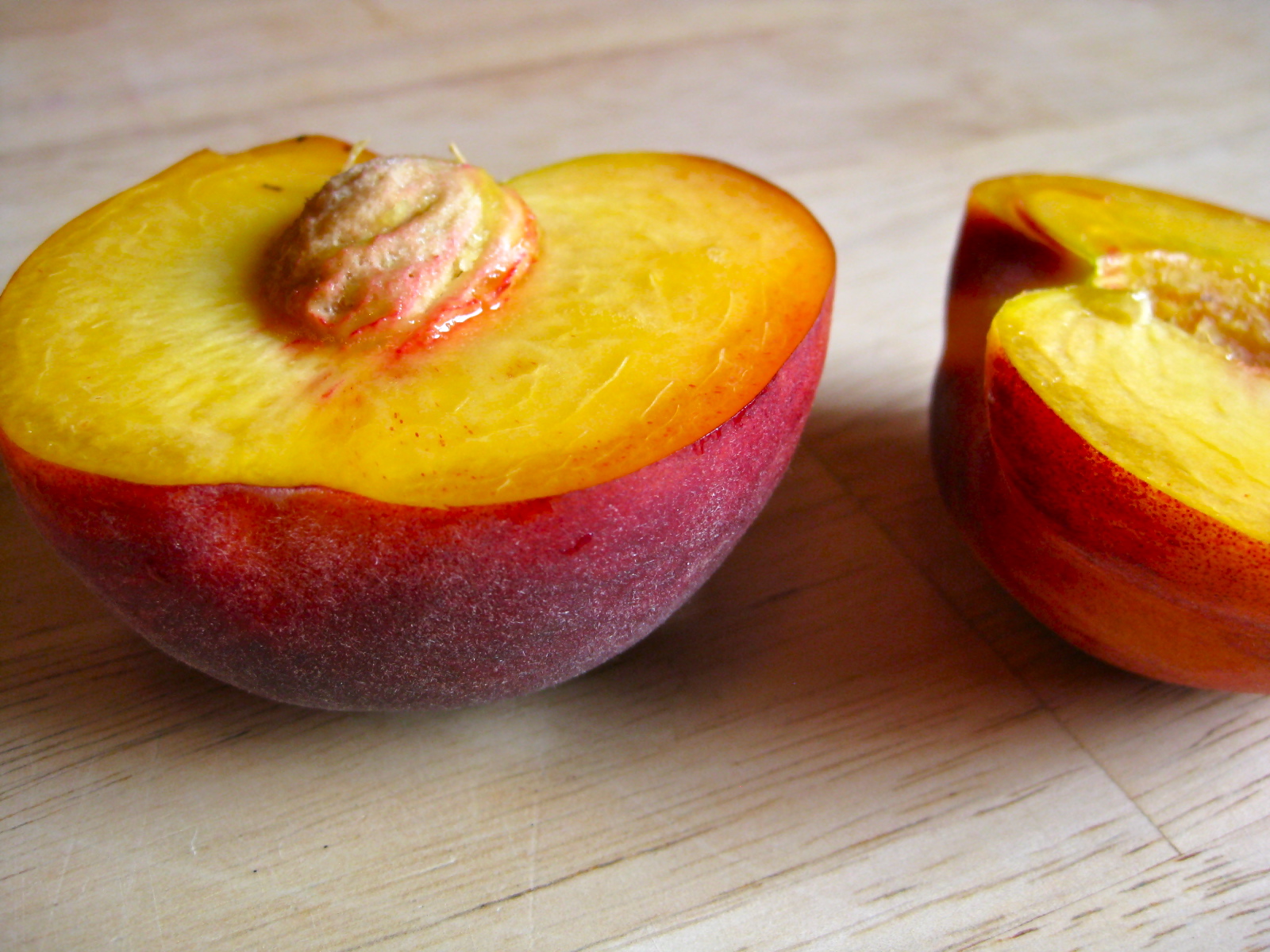
2 peaches, cut in half and the pits removed

4 link sausages (I used chicken fontina sausage, which was fantastic)

1 cup fine bulgur

2 ½ cups boiling water

½ cup gently packed fresh herbs of your choice (I used parsley, mint, and basil), finely chopped

¼ cup whole almonds, coarsely chopped

½ tablespoon butter

salt and pepper to taste

In a medium bowl, combine bulgur with boiling water.  Stir to combine, then cover tightly and allow to stand for 30 minutes.

Heat an outdoor grill or a grill pan on top of the stove to medium high heat.  Brush the surface of the grill with vegetable oil.  Place peaches on the grill, cut side down.  Place sausages on the grill.  After 3 minutes of grilling, gently turn over one peach to see if grill marks have formed.  If grill marks are visible, turn over the remaining peaches, and continue to grill for another 3-4 minutes, until peaches appear juicy  and soft.  Remove peaches from grill, and continue to grill sausages, turning occasionally, until they are cooked through.  After being cooked, both peaches and sausages should be removed to a plate and covered.

When bulgur has soaked for 30 minutes, fluff with a fork and taste for doneness.  Bulgur should be soft and fluffy in consistency.  Drain bulgur in a fine mesh sieve to remove any remaining water, then return to the bowl in which is soaked.  In a small pan, heat butter over medium low heat.  When butter has melted, add chopped almonds and gently fry in butter, stirring occasionally, until almonds have started to brown, about 3 to 5 minutes.  Add almonds to bulgur.  Add chopped herbs to bulgur.  Add salt and pepper to taste, and toss to combine.

To serve, slice each sausage on the diagonal into oval coins.  Slice each peach half into fifths.  Serve peaches and sausages on top of bulgur, pouring over any juices that collected on the bottom of the plate on which the peaches and sausages were resting.

Serves 4.

Is Anybody Else Mildly Disturbed/Fascinated by This?

20 Jul

In the older of my two copies of Joy of Cooking, there seems to be a holdout to a bygone era.  The older edition was printed in 1985, but it seems as though many of the recipes were developed and deemed significant during a time when people relied a bit more than is currently necessary on particular types of wild game.  I only say this because, tell me, when was the last time you had a hankering to blanch and roast one of these fine fellows?

(Note the instructions on how to fatten up one’s opossum by feeding it milk and cereals for 10 days prior to cooking it, as though you are the dutiful game-eating cousin of that witch in Hansel and Gretel.)

Still, if porcupine’s not your bag, might I suggest another item?

Of course, if you are feeling a bit less peckish, it might be recommend that you prepare something a bit smaller.  You know, for a light lunch or afternoon snack.

That ought to hit the spot nicely.  I don’t know about you, but  I find the accompanying menu suggestion incredibly helpful.  You wouldn’t want to serve your braised muskrat with a clashing side dish.  That would just be embarrassing.  But what’s that you say?  Muskrat not fulfilling your needs?  Too big, you say?  Then don’t hesitate to try out one of these.

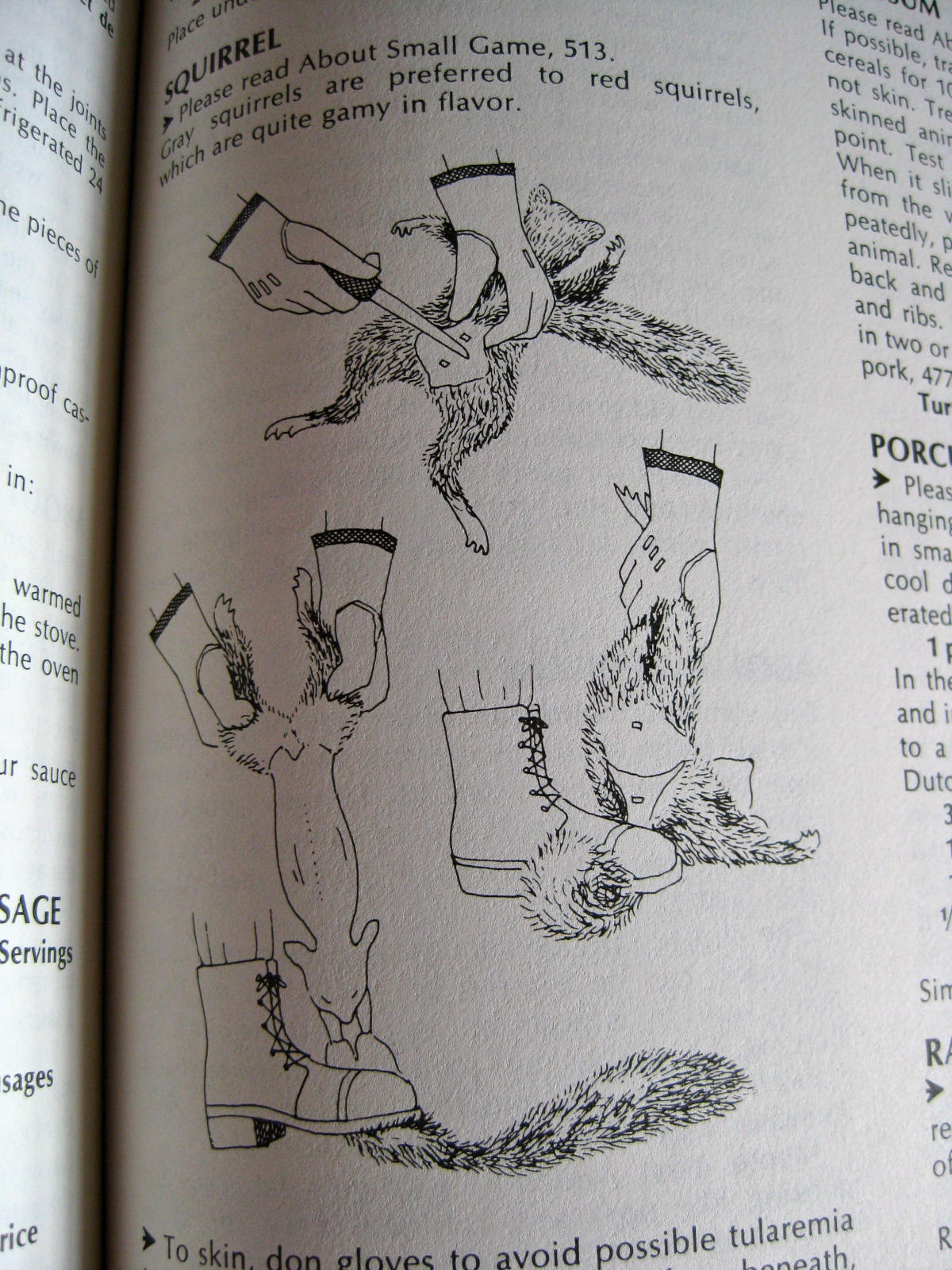
And don’t worry if you are unsure about how one might go about preparing such an animal for eventual mealtime delight.  Joy of Cooking has totally got your back on that one.

Note the helpful warning to wear gloves (and, one can ascertain, very heavy boots) while skinning your squirrel, lest you contract tularemia, a terrible infectious disease caused by highly virulent bacterium found in wild rodents.  One can only assume that, once sufficiently cooked, the rodent in question will be deemed no longer in possession of the hideous pathogen.  Fingers crossed!

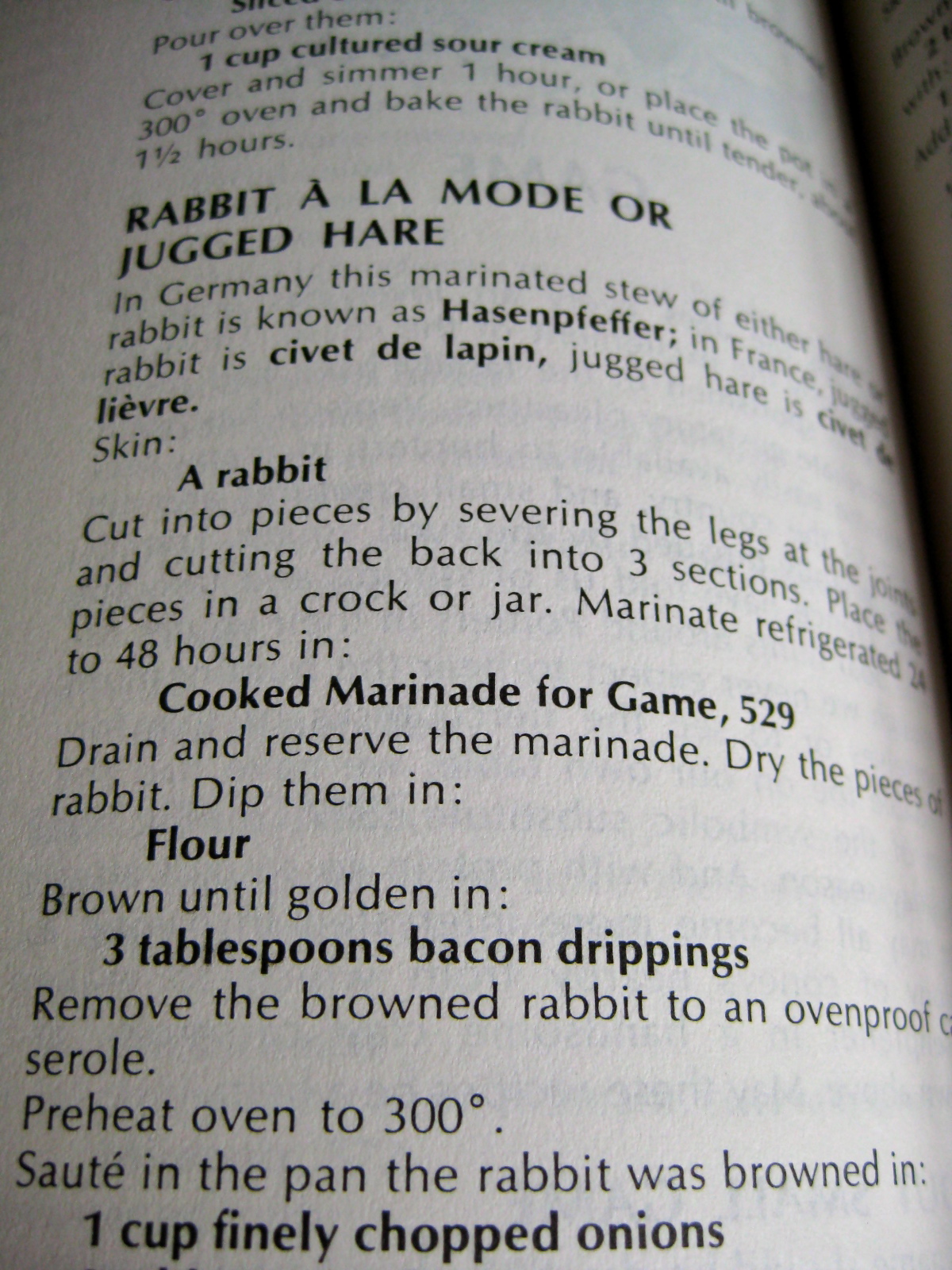
To be fair, there are some recipes in this section of the book (the Wild Game section, if you are curious) that fall a bit more on the side of normal.

While I would never admit as much to my son, devotee of all things rabbit related, I have actually tasted rabbit before, though I cannot recall whether I enjoyed it or not.  And though I did not prepare the rabbit in question, I can rest assured that, were I ever to find myself struck with that particular need (or the need to relieve a rabbit of its sweater while it hung upside down on a trapeze), Joy of Cooking, circa 1985, will most definitely have my interests in mind.

Bonus question: Does anyone else find it hilarious that the recipes for these particular items never deviate from the standard Joy of Cooking format?  I find it endlessly pleasing that the recipe for raccoon indicates that, in order to cook raccoon, you will need:

1 raccoon

And in order to cook muskrat, the ingredients list commands that you procure:

1 muskrat

Thanks, Joy of Cooking.  Utterly efficient to the end.

P.S. Yeah. I totally filed this post in the Meat category.

Cherry Almond Strudel

18 Jul

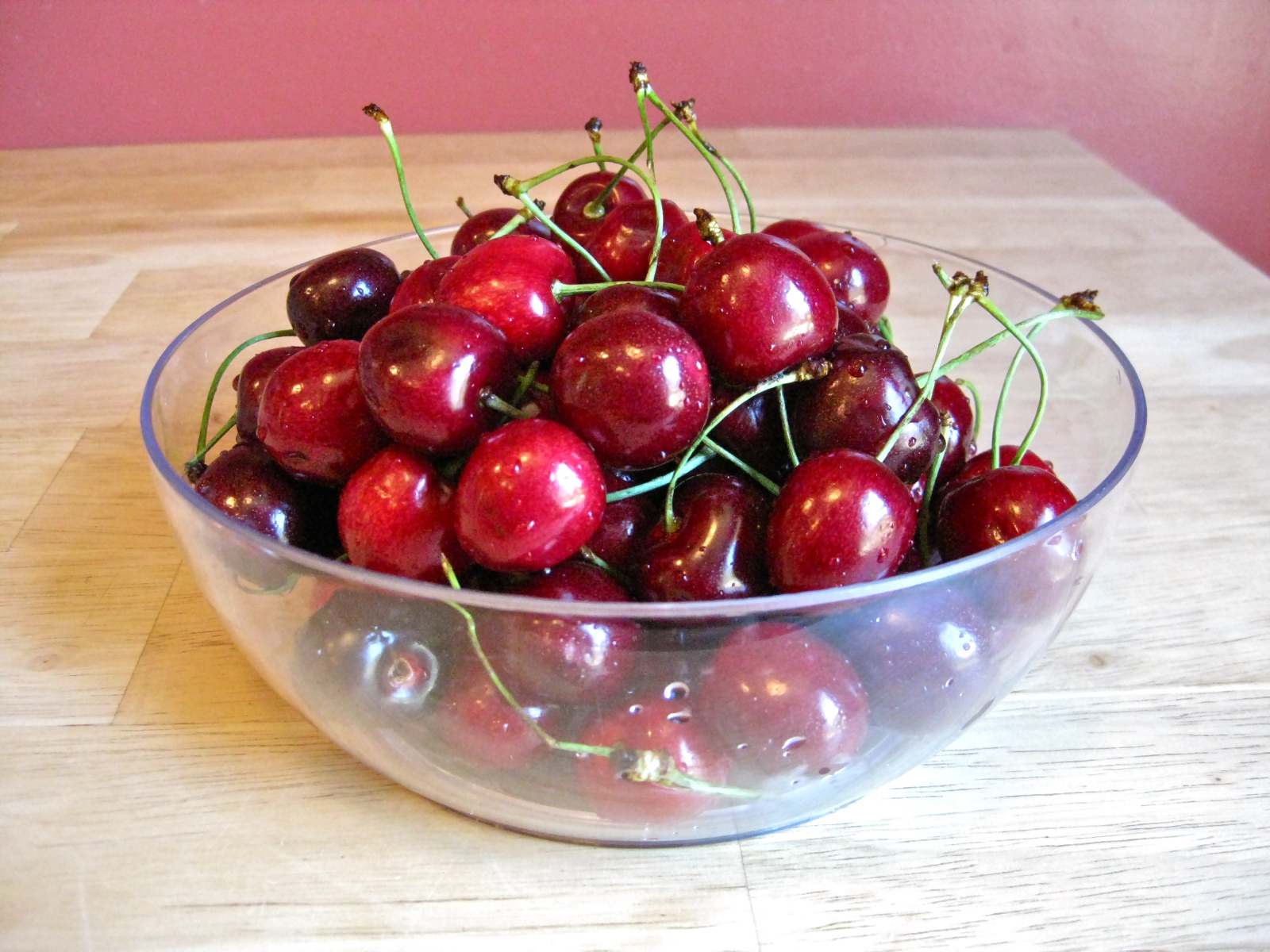
Do you enjoy seemingly infinite layers of shatteringly crisp phyllo?  What are your feelings concerning rich, dark cherries?  How about a dash of almond in each bite playing off of the lingering almond scent of cherry pits?  You approve?  Great!  You want to make this.

But then there’s the other side of the equation.  Pitting a pound and a half of cherries.  Layering each sheet of phyllo, brushing it with butter, and then sprinkling it with a dusting of ground almonds and spices.  Repeating that process many, many times.  Maybe you don’t want to make this.

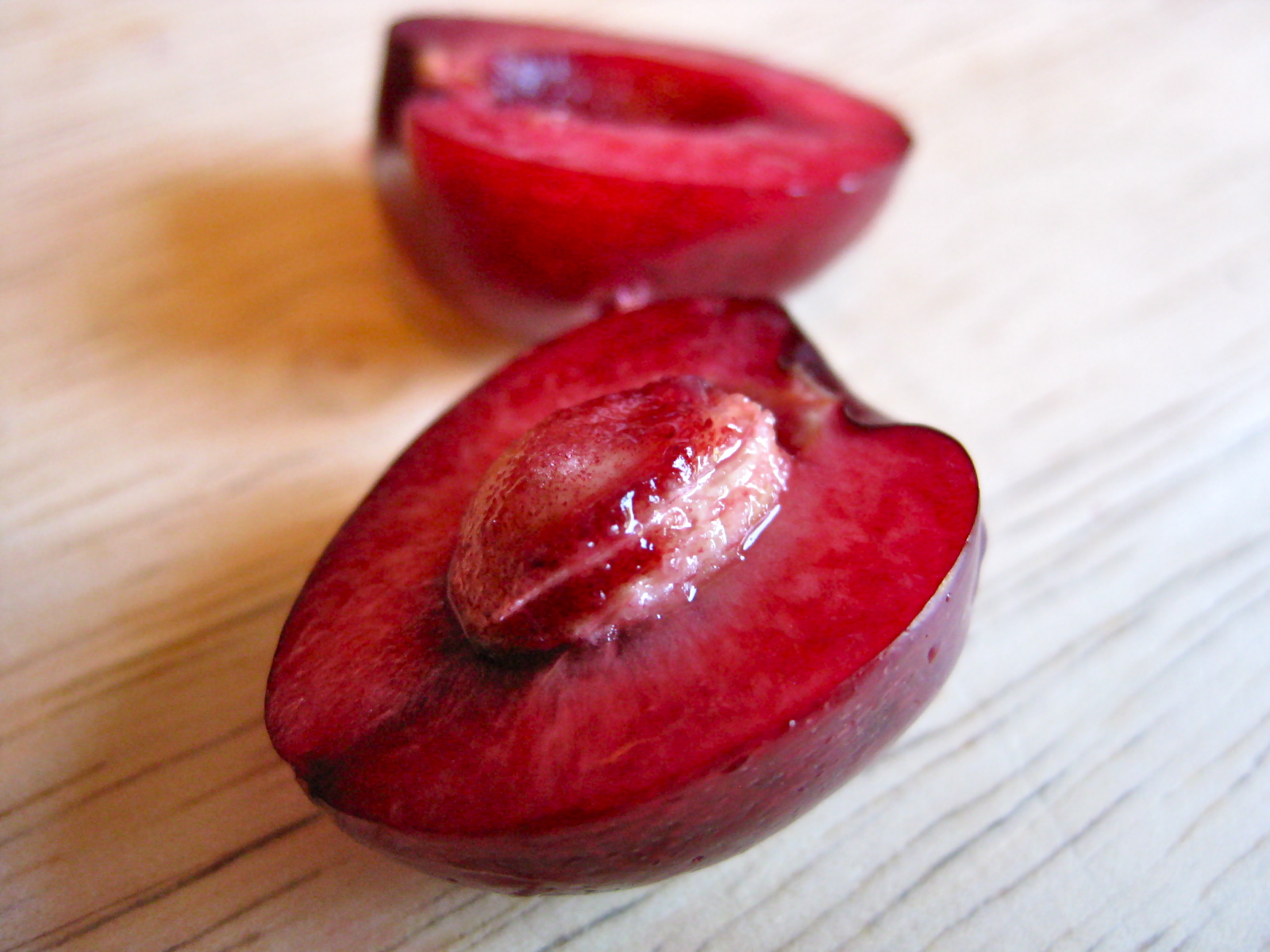
But, wait!  You do!  I know this strudel might look like something only a person who is really into self punishment might attempt, but I swear to you that, start to finish, it’s really not all that time consuming or difficult.  Yes, I pitted a pound and a half of cherries by cutting each cherry in half and removing the pit by hand, one by one, but the entire operation only took me, start to finish, fifteen minutes.  And, true, layering the sheets of phyllo and then brushing and sprinkling each one can seem like a monumental task, but, in reality, it’s not the type of activity that one needs a graduate degree in Food Science to complete.

Again, it’s a process that will take you fifteen minutes, tops, and you certainly won’t be any worse off having taken a stab at it.  In fact, at the risk of sounding like a complete loon, I actually enjoy the process of methodically layering phyllo.  Perhaps it is the repetitive nature of a rather short task that produces immediately, visible results, but I find the motions rather soothing.

But forget all of that.  Whether or not you fear the task of making this strudel, I can assure you of one sure thing: you will definitely, without a doubt, immensely enjoy eating this strudel.  Again, flakey layers of crisp phyllo.  Plump and perfect cherries.  Sweet, syrupy juice mingling with a hint of almond.  No, really. You want to make this.

Cherry Almond Strudel

½ pound of phyllo sheets, defrosted if frozen

4 tablespoons melted butter

½ cup finely ground almonds or almond meal

½ teaspoon cinnamon

½  cup dark brown sugar, divided

1 ½ pounds cherries, cut in half and pitted

2 tablespoons quick-cooking tapioca

1 tablespoon freshly squeezed lemon juice

1/8 tsp almond extract

pinch of salt

Preheat oven to 400 degrees Fahrenheit.  Line a baking sheet with parchment paper and set aside.

In a large bowl, combine ¼ cup dark brown sugar, pitted cherries, tapioca, lemon juice, almond extract, and pinch of salt. Toss to combine thoroughly, then set aside.

In a small bowl, combine ground almonds, cinnamon, and remaining ¼ cup dark brown sugar.  Reserve 1 tablespoon of mixture and set aside.

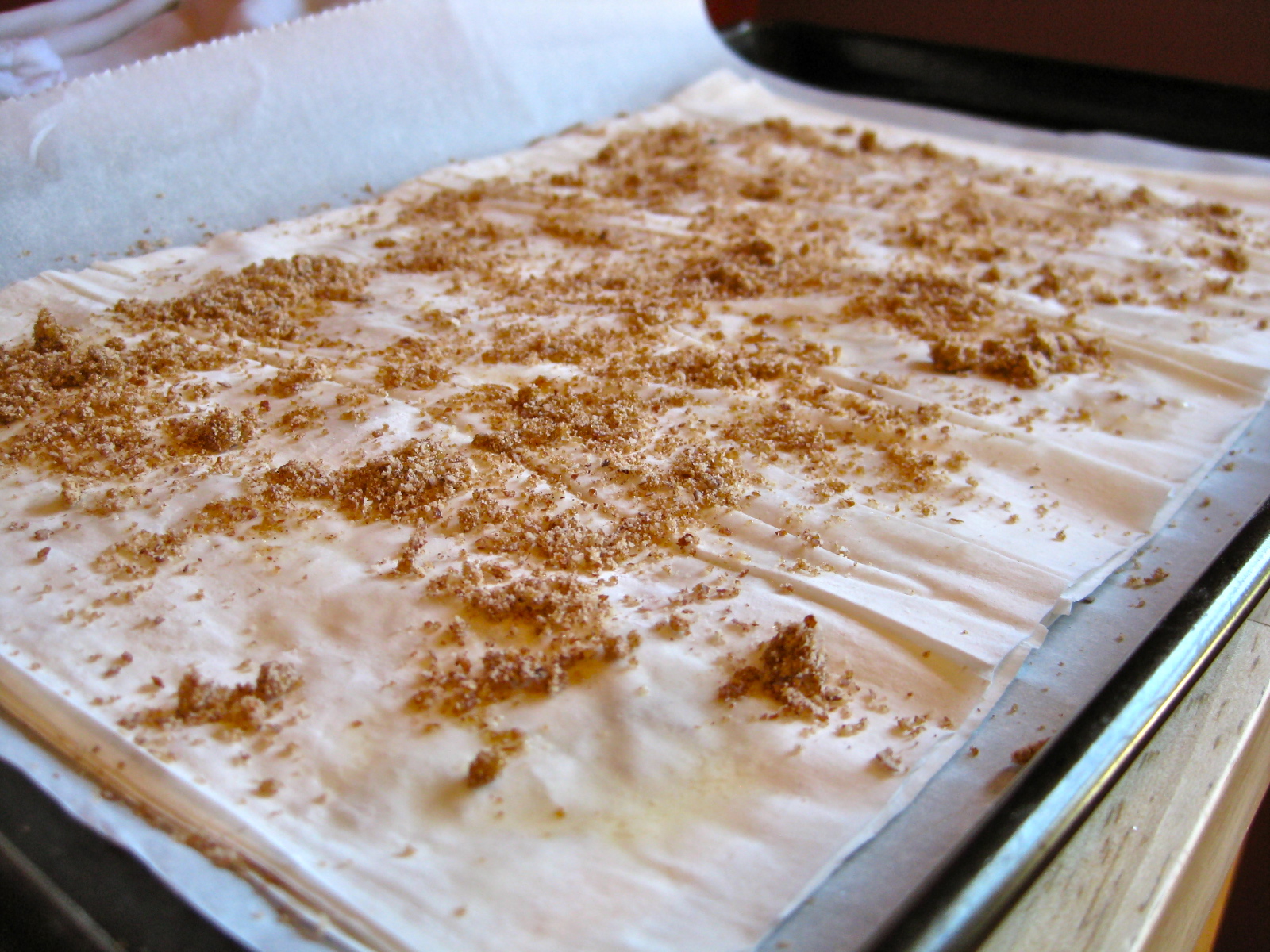
Cover unrolled phyllo stack with a lightly dampened kitchen towel (this will keep the phyllo from drying out as you work).  Take two phyllo sheets from stack and lay them down on your parchment-lined baking sheet with a long side nearest you (keeping remaining sheets covered as you work) and brush lightly with butter.  Evenly sprinkle surface of buttered phyllo with a heaping tablespoon of ground almond mixture.  Continue layering, buttering, and sprinkling in this fashion until all of the phyllo sheets have been used.  The number of layers you will have will depend largely on the size of your phyllo sheets.

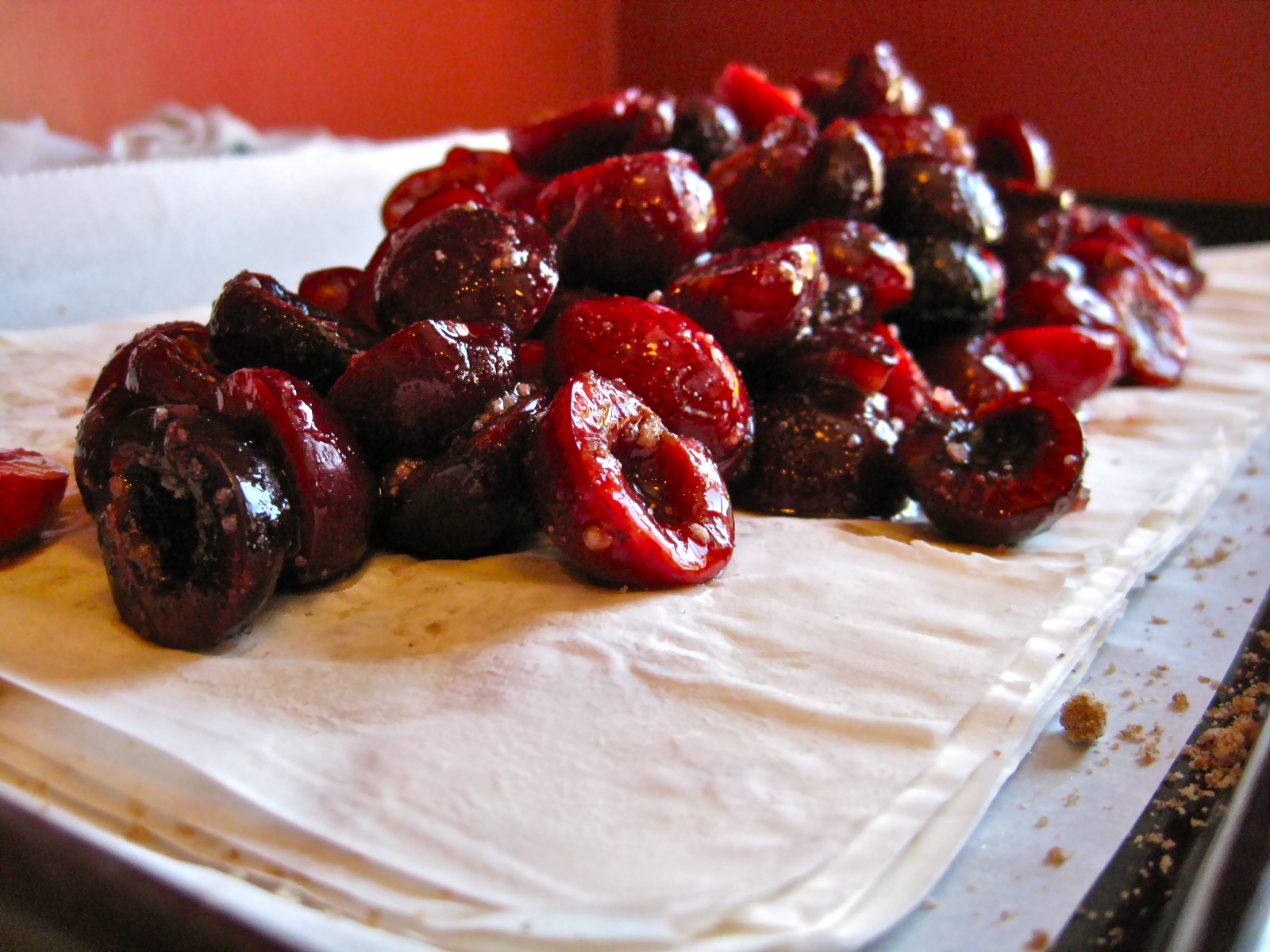
When all of the phyllo has been layered and prepared, spoon the cherry mixture on top of the phyllo stack, doing your best to arrange most of the cherries on the long half of the phyllo that is closest to you.  Carefully roll the cherry-topped phyllo sheets into a large log, tucking in the short ends as you go.  Arrange the roll seam side down.

Brush the top of the strudel with the last drops of melted butter, then sprinkle with reserved tablespoon of almond mixture.  Using a sharp knife, cut two or three steam vents along the top of the strudel.

Bake strudel in center rack of oven for 30-40 minutes, until cherry mixture is bubbling and the strudel is a deep golden brown.  Cool strudel on baking sheet for at least 30 minutes before attempting to cut and serve.